Absolute Strength and Relative Strength
What’s the Difference Between Absolute Strength and Relative Strength?
In rugby, strength is one of the most important physical qualities that separates elite players from the rest. Whether it’s driving through a tackle, scrummaging, or breaking the gain line, strength underpins nearly every action on the field (1). But not all strength is created equal. Two key concepts—absolute strength (think big powerlifter doing a squat) and relative strength (think muscular gymnast) —play distinct roles in performance. Understanding the difference between them can help players and coaches design smarter training programmes that translate directly to improve on-field performance.
Absolute Strength: The Total Force Produced
Absolute strength refers to the maximum amount of force a player can produce, regardless of body weight. It’s the raw, total strength an athlete can generate in a single effort. For example, if a prop forward can deadlift 260 kg, that number represents their absolute strength in that lift. It’s a measure of pure output and is often tested through one-rep max (1RM) lifts such as the squat, bench press, or deadlift (3).
In rugby, absolute strength is particularly valuable for positions that rely on brute force and physical dominance. Front-row players, locks, and powerful ball carriers benefit from high levels of absolute strength because it allows them to exert greater force in collisions, scrums, and mauls (4). The stronger the player, the more effectively they can potentially impose themselves physically on the opposition.
However, absolute strength alone doesn’t tell the full story. A heavier player might lift more weight simply because they have more muscle mass, but that doesn’t necessarily mean they’re stronger relative to their size (5).
Relative Strength: Strength in Proportion to Body Weight
Relative strength measures how strong a player is in relation to their body weight. It’s calculated by dividing the amount of weight lifted by the athlete’s body weight. For example, if a 90 kg player squats 180 kg, their relative strength ratio is 2.0 (180 ÷ 90). This metric is crucial for understanding how efficiently an athlete can move their own body (3).
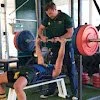
(79kg Outside Centre performing an in-season 170kg Box Squat for 3 reps.)
In rugby, relative strength is especially important for positions that require speed, agility, and repeated high-intensity efforts—such as backs and mobile forwards. A player with high relative strength can accelerate faster, change direction more effectively, and maintain power output throughout the game (5). It’s not just about how much weight they can lift, but how well they can apply that strength dynamically on the field (2).
Balancing Both for Rugby Performance
The best rugby players develop both absolute and relative strength. Building absolute strength provides the foundation for force production, while improving relative strength ensures that force can be expressed efficiently during movement. For example, a flanker who increases their squat from 130 kg to 160 kg while maintaining body weight will likely see improvements in tackling power and sprint acceleration (4). In fact, this is often the case in preseason where players are super focussed and have the time and freedom (no contact week in and week out) to home in on physical adaptations. There are several examples from Biella Rugby over the years. Martin is a classic - he’s a 6ft 5” back row/ lock forward who is really agile in the lineout but (at the time) could use more leg strength to help him make more dominant tackles and line breaks. Martin followed a six-week block of training where he squatted twice per week, coupled with various plyometrics. He increased his body weight by 4kg and took his squat from 130 kg 1RM to 160 kg 1RM. He improved his bronco score by 15s and ran 10 metre and 30 m personal bests - at a heavier body weight! His absolute strength obviously increased by 30 kg; however, his relative strength score improved too, from 1.35 to 1.53.
(Martin’s 10 and 30 metre scores improved along with his lower body strength - for realtime training, follow along on Instagram @Coachfmt.)
Training programmes should reflect a blend of positional demands and individual needs. Front-row players may prioritize absolute strength through heavy compound lifts, while backs might focus on relative strength with a combination of strength, speed, and power training. I’ll often pull our fast guys back from doing unnecessarily heavy top-sets in-season if they’ve already hit the marker and dosage for maintaining strength. Example, Jack FB might only load up to 160kg for 3 on the trap bar deadlift despite being able to pull 210kg for 3. Jack (and the other fast guys) will often tell me they can do more that day, but if they’re pulling 2 x body weight for 3 on their bilateral strength lift there’s just no need to push it further (occasionally there are exceptions, I’ll save that for another post). In contrast, a young prop might be getting absolutely smashed in the squat rack on a Tuesday after a game because strength takes time and in the long term, they’ll thank me...
In short, absolute strength is about how much force can be produced, while relative strength is about force output per kg of body weight. The most effective rugby athletes understand that getting bigger can be an advantage in rugby — but finding the right balance and increasing strength is equally important when considering relative strength.
References
Baker D. Comparison of upper-body strength and power between professional and college-aged rugby league players. J Strength Cond Res. 2001;15(1):30–5.
Turner AN, Stewart PF. Strength and conditioning for rugby union: Current training practices and future directions. Strength Cond J. 2014;36(6):1–14.
Suchomel TJ, Nimphius S, Stone MH. The importance of muscular strength in athletic performance. Sports Med. 2016;46(10):1419–49.
Crewther BT, Kilduff LP, Cook CJ, Middleton MK, Bunce PJ, Yang GZ. The acute potentiating effects of back squats on athlete performance. J Strength Cond Res. 2011;25(12):3319–25.
Comfort P, Bullock N, Pearson SJ. A comparison of maximal squat strength and 5-, 10-, and 20-meter sprint times in athletes. J Strength Cond Res. 2012;26(4):937–40.